
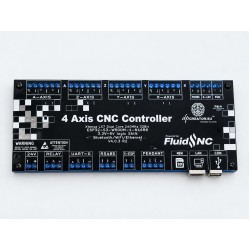
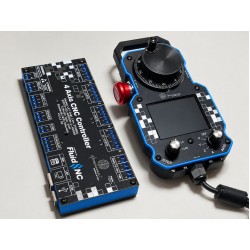
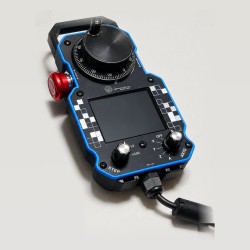
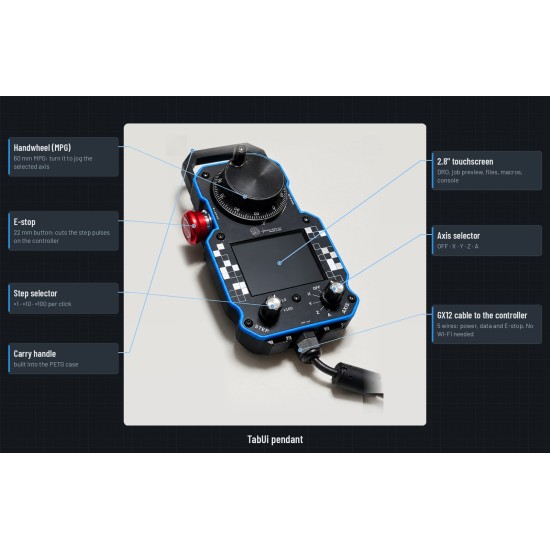
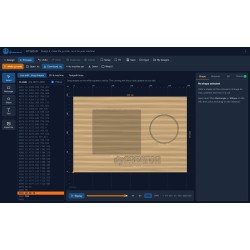
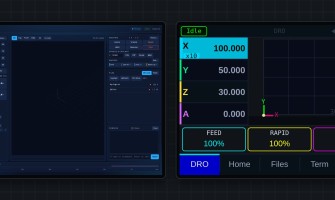
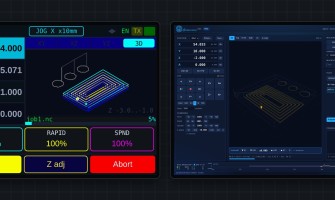
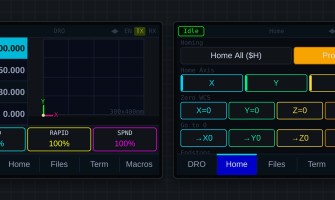
These are the earlier dpCREATOR controller boards. They are discontinued and no longer sold. This page shows them for reference and to help owners identify their board. The current board is the dpCREATOR R2/R3.
ESP32 boards (FluidNC)

v4.0.4 (modular)
A modular version of the v4 board. A carrier board with the screw terminals, relay, USB and an RJ11 port takes plug-in modules: the PLC V2.0.1 core, a 4-axis motion control module, a 0–10 V PWM module for the spindle and a 24 V to 5 V DC-DC power supply. Each part could be replaced on its own.


R1 (v4.0.2)
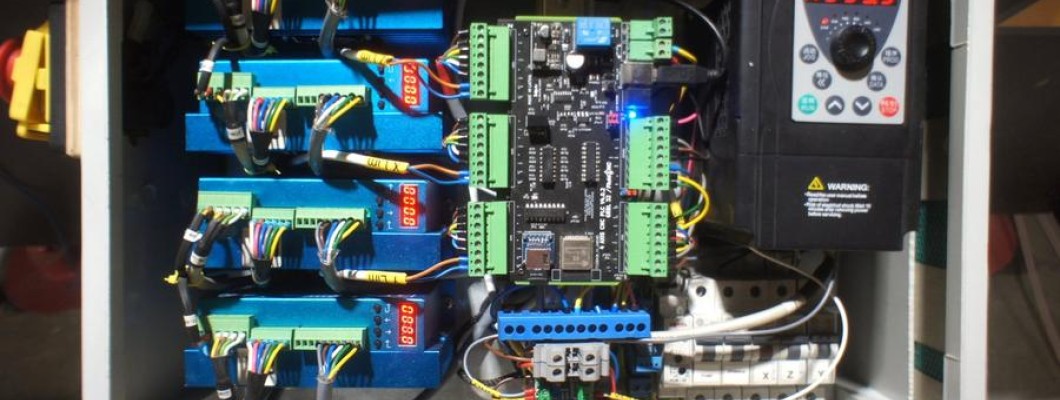
The “4 Axis CNC PLC”, marked GRBL 32 / FluidNC. It has an ESP32 module on the board, a microSD card slot, a relay output, USB, and screw terminals for four step/direction axes and the inputs. The photos show it in a working machine, driving four external stepper drivers and a VFD spindle.
The R1 was the first board in the R series. What was learned from it went into the R2 and R3.

v3.0.2 (v1)
A carrier board for a standard ESP32 dev module. The dev module plugged into the board instead of an ESP32 being soldered on.
Atmel boards (GRBL 1.1)
The project started on the Atmel ATmega328P, running GRBL 1.1. These boards were made by 3dp.lv Ltd, the company behind the boards before dpCREATOR.


3 Axis CNC Shield V1.2
A complete GRBL 1.1 controller with the ATmega328P on the board and 5 V logic. It has step, direction and enable outputs for X, Z and two Y motors with separate Y limit switches (dual Y endstops for squaring a gantry). It also has spindle enable and PWM, probe and abort inputs, a 12 V supply input, a USB + LCD connector, and a header for an optional HC-06 Bluetooth module.

UNO screw-terminal shield: where it started
The first version of the project. It ran GRBL on an Atmel ATmega328P UNO board and was made for machines with external stepper drivers. We built it because we didn't like the cheap CNC shields with plug-in driver modules.
The shield plugs on top of the UNO and brings its pins out to five rows of screw terminals, labelled for the step, direction, limit and enable signals and ground, so drivers and switches could be wired without soldering.


UNO R3 CNC Edition
A UNO R3 compatible board built with the most powerful UNO chip available at the time, with USB and a DC power jack, made to run GRBL under a CNC shield.